Darren Hosiosky
Ignition vs GoProposal vs Admiin: Proposal, Engagement & Lodgement Tools Compared
If you've been in Australian accounting practice management long enough, you'll remember when Practice Ignition was the obvious answer to "how do I send a proposal and an engagement letter and collect the payment automatically?" The product has since rebranded to Ignition (in 2021), and a credible competitor — GoProposal by Sage (acquired by Sage in 2021) — has emerged.
Both are aimed at the same problem: replacing the slow, manual process of sending proposals and engagement letters with something automated, signed, paid for, and tracked.
But there's a third option Australian firms increasingly include in this conversation: Admiin. Admiin doesn't compete on initial proposals — it's purpose-built for the per-lodgement workflow that runs every tax return cycle, where Ignition's recurring billing falls short. For firms wanting both pieces of the puzzle, the right comparison is a three-way one.
First — the rebranding question
This trips people up constantly:
Practice Ignition and Ignition are the same product. Rebranded in 2021.
GoProposal is a separate product, acquired by Sage in October 2021.
The 30-second version
Ignition is the all-in-one revenue engine: proposals, engagement letters, e-signatures, automated billing, payment collection, AR automation. The Australian default for front-of-funnel automation.
GoProposal is the pricing-and-proposal specialist. Brilliant at building consistent, menu-driven pricing models. Smaller AU footprint, larger UK footprint.
Admiin is the per-lodgement execution engine. It doesn't compete on initial proposals — it handles the workflow every time a return is finished: cover letters, signing, AML, ATO payment, lodgement. The core platform is free. Works alongside Ignition or GoProposal.
Pricing comparison
Ignition | GoProposal by Sage | Admiin | |
|---|---|---|---|
Primary use case | Proposals + engagement + recurring billing | Pricing + proposals + engagement letters | Per-lodgement workflow (sign, pay, lodge) |
Entry plan | Solo: AU$39/month annual (<$200k revenue) | Around AU$120/month (Bronze tier) | Free |
Mid plan | Core: AU$99/month annual | Silver: ~AU$200/month | Free |
Pro plan | Pro: AU$199/month annual | Gold: ~AU$260/month | Free |
Top tier | Pro+: AU$399/month annual | Platinum: ~AU$390/month | $800/month white-label (optional) |
Payment processing | 1% + $0.30 per transaction (capped $5; +0.3% above $3k) | Via add-on or external | Card surcharge passed to client |
E-signatures included | Yes | Yes | Yes |
Per-lodgement cover letters | No | No | Yes (AI-generated) |
AML/CTF for AUSTRAC | No | No (UK-focused module) | Yes |
ATO payment integration | No | No | Yes (with full reward points to client) |
Tax binding | No | No | Yes |
Free trial | 14 days | 30 days | Always free (no trial needed) |
Important caveat on Ignition: payment processing fees are billed separately from the subscription. For a firm collecting $500k/year through Ignition, transaction fees alone can add ~$5,000+ to the annual cost.
What Ignition does well
1. All-in-one revenue workflow
Ignition's central pitch and it largely delivers: proposal → sign → payment captured → engagement letter generated → invoice in Xero/MYOB → recurring billing starts. The whole revenue cycle, in one platform.
2. Mature AU integrations
Xero, MYOB and QuickBooks integrations are solid. The Xero integration in particular is excellent.
3. Automated AR
The genuine business case for Ignition: dramatically reduces accounts receivable (see how FeeSynergy, Ignition and Stripe compare for AU firms).
4. Recurring billing
For firms doing monthly retainers, monthly bookkeeping packages or quarterly compliance, Ignition's recurring billing engine handles the schedule, charges the card, and reconciles to Xero automatically.
5. AI Price Insights
Launched in 2025 — benchmarking your pricing against anonymised peer data.
What Ignition does less well
1. The pricing tool itself is decent, not great
Ignition can build proposals from line items, but it's not a "pricing engine" the way GoProposal is.
2. Hidden cost of payment fees
A firm pushing $300k+ a year through Ignition payments is looking at $3,000–5,000+ in annual processing fees on top of the subscription. Above $3,000 per transaction, an additional 0.3% kicks in.
3. Designed around proposals, not ongoing work
Ignition starts strong at the proposal stage and runs smoothly through recurring billing — but it's not built for the per-lodgement workflow that runs every tax return cycle.
4. No cover letters, AML or ATO payment
Once the engagement is signed and ongoing billing is set up, Ignition's job is done. Cover letters for individual lodgements, AML checks, ATO payment — all happen elsewhere.
What GoProposal does well
1. The pricing engine
GoProposal is built around the idea that accountants should price systematically, not by gut. The "Pricing Wizard" generates suggested pricing. The line-items engine lets you build a menu-driven pricing model that every partner uses consistently.
For firms whose pricing is "whatever Brett quoted last time," GoProposal can drive real revenue uplift through consistent pricing alone.
2. Engagement letter automation
Professional, customisable, automated.
3. Professional proposal output
Branded, structured, visually appealing.
4. Sage ecosystem integration
For firms in Sage Business Cloud, GoProposal integrates cleanly.
What GoProposal does less well
1. Less mature payment automation than Ignition
2. Smaller AU presence
Most strongly used in the UK. Smaller AU community.
3. UK-leaning pricing display
Pricing published in GBP. AU support is real, but product evolution is UK-led.
4. No per-lodgement workflow
Like Ignition, GoProposal owns the front of the funnel. Doesn't touch the per-lodgement execution.
What Admiin does well
Admiin is built for the workflow that runs every time a return is finished. The per-lodgement execution layer.
1. AI-generated cover letters
When a return is finished, Admiin drafts the cover letter from the return data — no manual templating, no Word docs floating around.
2. Tax bindings
Return + supporting documents + cover letter combined into a single signing package automatically.
3. E-signatures built in
Mobile-first signing with real-time tracking. No need for a separate DocuSign / Annature / FuseSign subscription.
4. AML/CTF for AUSTRAC Tranche 2
Integrated KYC and AML/CTF verification for individuals and entities — built specifically for Australian compliance requirements.
5. Pay the firm AND the ATO in one flow
Unique in the category. Clients can pay your invoice and their ATO bill in the same workflow — and pay the ATO by credit card, earning full reward points at their card's regular rate (vs. the reduced rate they'd get paying the ATO direct). For a client with a $300k tax bill, that's potentially $8,000–12,000 in points value.
6. The price
The core platform is free. No per-user fees, no envelope caps, no transaction fees on top. An optional white-label tier at $800/month gives firms a fully custom-branded client experience with all emails and notifications sent from the firm's own domain.
What Admiin does less well
1. Not a proposal tool
Admiin doesn't replace Ignition or GoProposal for the front-of-funnel work. New client proposals, engagement letters and recurring billing are still Ignition's or GoProposal's strength.
2. Not a CRM
If you need a sales pipeline, lead management or full CRM, look elsewhere.
3. Built for accounting, not general agencies
Ignition serves agencies, consultants, financial advisers. Admiin is specifically built for tax & compliance firms.
Which one should your firm pick?
Pick Ignition if:
You want one platform for proposals, engagement letters and ongoing payment collection
You do recurring billing (monthly retainers, quarterly compliance)
You're on Xero / MYOB / QuickBooks
You can absorb transaction fees
Pick GoProposal if:
Your single biggest problem is inconsistent pricing across partners
You want a structured, menu-driven pricing approach
You're in the Sage ecosystem
Pick Admiin if:
Your bottleneck is the per-lodgement workflow (every return cycle)
You want cover letters, signing, AML, payment and lodgement in one flow
You want to offer clients ATO payment by credit card with full reward points
You want to start without paying anything
Most firms run a combo: Ignition (or GoProposal) for new client onboarding and recurring billing, plus Admiin for the per-lodgement workflow that fires every time a tax return is finished.
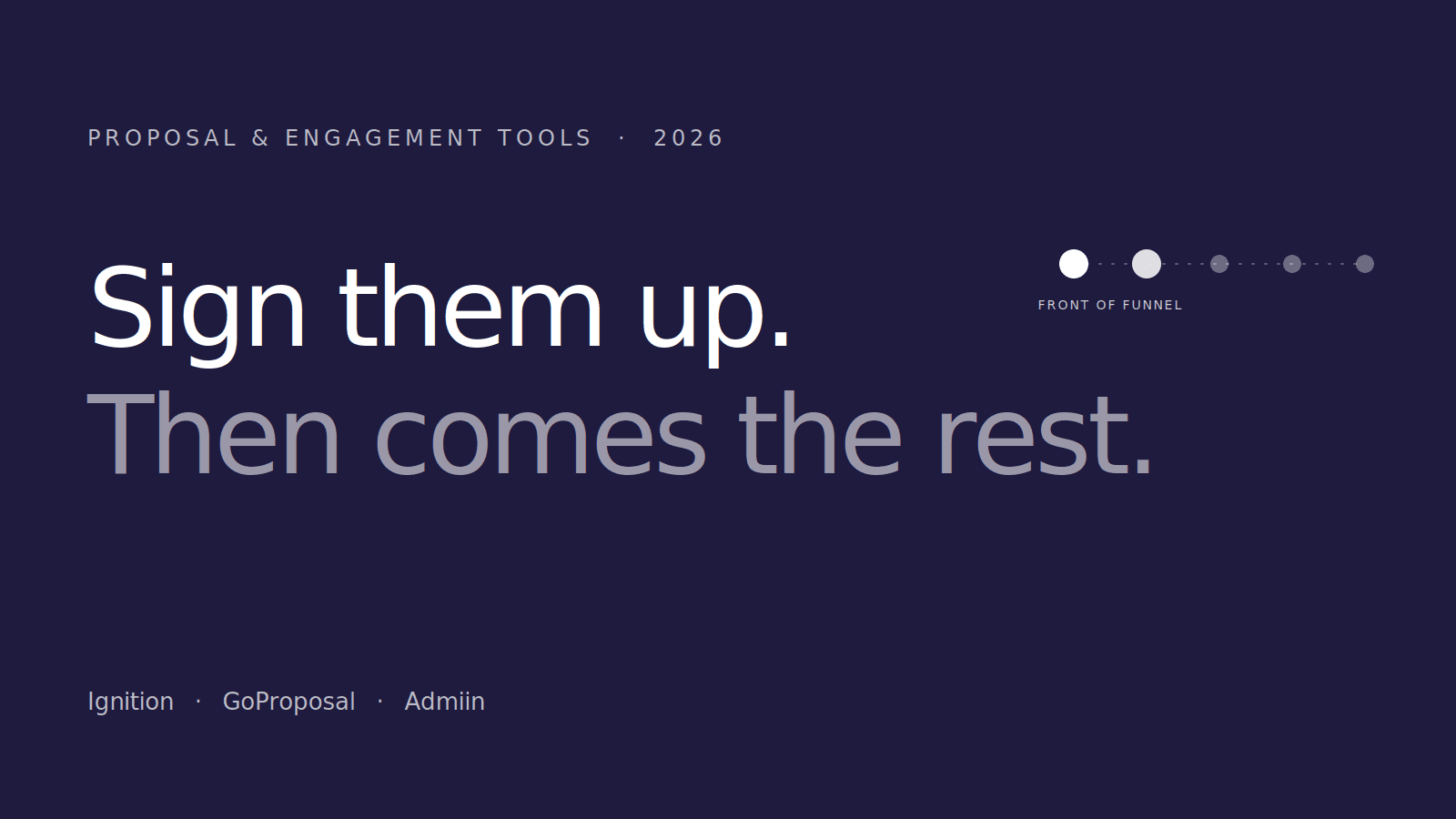
💡 Ignition owns the front of the funnel. Admiin owns every lodgement.
They don't compete — they complement. Ignition signs the engagement. Admiin runs every return cycle inside it: cover letter, signing, AML, ATO payment, lodgement. Free to start. Try Admiin →
What both Ignition and GoProposal leave on the table
Both tools are excellent at the front-end of the client lifecycle — proposal, engagement letter, signing, payment for the engagement itself.
But neither tool handles the ongoing tax workflow that happens after engagement, for every return cycle:
Tax return is finished ✅ (in your PMS)
Cover letter for this lodgement is generated ❌
Return + cover letter + supporting docs are bound ❌
Document is sent for e-signing ❌
AML/CTF check is run (AUSTRAC Tranche 2) ❌
Client pays this year's invoice ⚠️ (Ignition can recurring-bill, but doesn't tie to this specific return)
Client pays the ATO ❌
Return is lodged ❌
These steps — the per-lodgement execution layer — are where firms still bleed time even after Ignition has solved the engagement piece.
Admiin is built specifically for this. AI cover letters, tax bindings, e-signatures, AML/CTF, ATO payment by card (with full reward points to the client), and lodgement — all in one workflow that triggers each time a return is finished. Free to start.
FAQs
Is Practice Ignition still around?
Same product, rebranded as Ignition.
Can I use Ignition just for proposals?
Yes, but you'd be paying for an all-in-one platform and using a fraction of it.
Does Ignition work with Karbon?
Yes — Ignition integrates with Karbon. When a proposal is signed, the job and contact are created in Karbon automatically.
Does Admiin replace Ignition?
No. They cover different parts of the client lifecycle. Ignition handles new client onboarding and recurring billing; Admiin handles the per-lodgement workflow that fires every return cycle. Most firms run both.
Does Admiin do recurring billing?
Admiin focuses on per-lodgement workflows. For recurring billing (monthly retainers, etc.), Ignition is the better fit. They work well together.
What's the real cost of Ignition for a 5-person firm?
On Pro plan ($199/month annual) plus payment processing on ~$400k revenue: ~$2,388 subscription + ~$3,000–4,000 transaction fees = ~$5,500–6,500/year all-in.
What does Admiin cost?
Free for the core platform. No per-user fees, no envelope caps, no transaction fees on top of the standard card surcharge. Optional white-label tier at $800/month gives full custom branding and emails/notifications from your firm's own domain.
Does Admiin include AML/CTF?
Yes — Admiin includes integrated AML/CTF verification for AUSTRAC Tranche 2 compliance.
The bottom line
Ignition is the all-in-one revenue engine for new clients and recurring billing. GoProposal is the pricing-and-proposal specialist. Admiin is the per-lodgement workflow that fires every time a return is finished.
These aren't competing answers to the same question — they're three different parts of the client lifecycle. The modern AU accounting stack typically combines one front-of-funnel tool (Ignition or GoProposal) with Admiin for the per-lodgement workflow. Admiin's free to start, so there's no reason not to add it.