
Darren Hosiosky
If you ask an Australian accounting partner what their biggest operational frustration is, "getting paid" comes up more than almost anything else. Debtor days, late payments, awkward follow-ups, the dance around fee finance — it's all unglamorous and surprisingly under-discussed.
There are four serious tools an Australian firm considers for getting paid in 2026: FeeSynergy (the AU-built debtor management specialist), Ignition (the revenue automation platform), Stripe (the generic payment processor), and Admiin (https://www.admiin.com) (the free per-lodgement workflow that handles both the firm's invoice and the ATO payment in one flow).
They solve overlapping but different problems. This is an honest comparison.
The 30-second version
FeeSynergy is built specifically for accounting firms with debtor management problems. Automated reminders, direct debits, fee finance. Used by Pitcher Partners, HLB Mann Judd, Nexia.
Ignition is the revenue engine. Proposals, engagement letters, signature-with-payment-capture, automated recurring billing. Eliminates AR upfront.
Stripe is the payment processor. It charges cards. It doesn't reduce debtor days.
Admiin is the per-lodgement payment workflow. It combines payment to your firm and payment to the ATO (with full reward points to the client) in one flow — alongside cover letters, signing, AML and lodgement. Core free; optional white-label $800/month.
Quick comparison
FeeSynergy | Ignition | Stripe | Admiin | |
|---|---|---|---|---|
Primary problem solved | Debtor management, AR automation | Proposal-to-payment, recurring billing | Card payment processing | Per-lodgement workflow (firm + ATO payment, signing, AML, lodgement) |
Pricing model | Custom (per firm) | $39–$399/month AUD annual | Per transaction (1.7% + 30¢ AU cards) | Free core; $800/mo white-label optional |
Direct debits | Yes ($0.30 each) | Yes (via Stripe) | Yes (PayTo, BECS) | Yes |
Recurring billing | Yes | Yes (excellent) | Yes (build it yourself) | Per-lodgement focused |
Engagement letters | Yes (FeeSynergy Engage) | Yes | No | Yes (lodgement-specific) |
Fee finance / instalments | Yes (integrated) | No | No | Yes (client choice) |
Pays the ATO | No | No | No | Yes (with full reward points) |
AML/CTF for AUSTRAC | No | No | No | Yes |
Cover letter generation | No | No | No | Yes (AI) |
Lodgement | No | No | No | Yes |
PMS integrations | MYOB AE/AO, APS, Xero, GreatSoft, CCH | Xero, MYOB, QuickBooks, Karbon, XPM | API only | Xero, MYOB, your PMS |
Built for | Accounting and legal firms | Service businesses (strong in accounting) | All industries | AU tax & compliance |
Founded / based | Australia | Australia | USA | Australia |
FeeSynergy: the debtor management specialist
FeeSynergy is the Australian-built tool that's been doing debtor management for accounting firms for 16+ years. It does one thing extraordinarily well: it reduces your debtor days.
Their flagship product, FeeSynergy Collect, integrates with every major AU practice management system (MYOB AE/AO, APS, Xero, GreatSoft, CCH, Lexis Affinity):
Automated email reminders to outstanding debtors
Customisable workflow and dashboard reporting
Online card payments (PCI/DSS compliant)
Recurring direct debits ($0.30 each)
Integrated fee finance (clients can self-service into instalment plans)
Engagement letters (FeeSynergy Engage)
Outsourced AR service (FeeSynergy Outsourced)
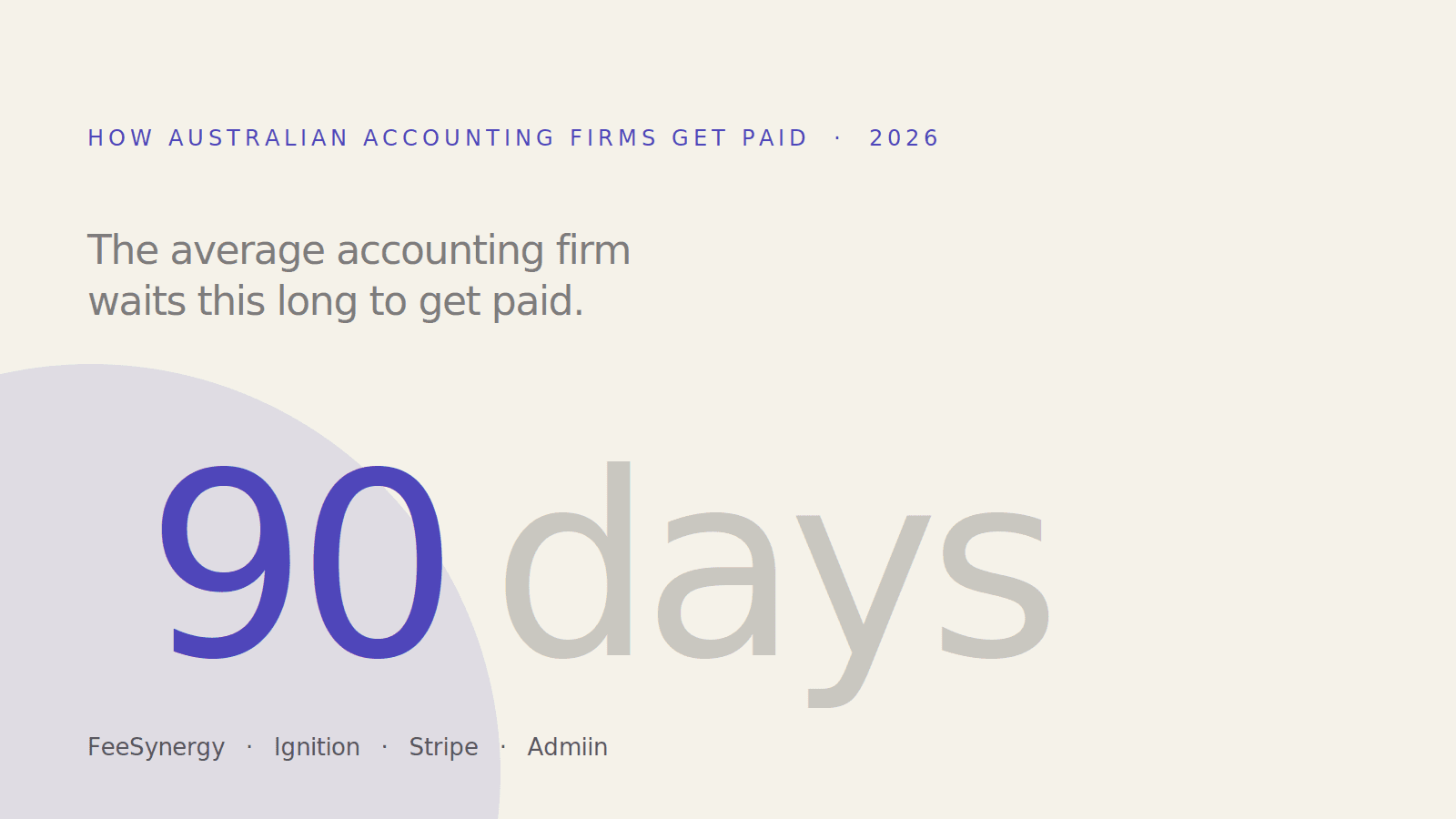
The pitch: most accounting firms have 60–90 day debtor cycles. FeeSynergy gets that down to under 30 days for most firms within 60 days of go-live.
Where FeeSynergy shines
Genuine debtor day reduction
Mid-to-large firm fit (Pitcher Partners, Nexia, RSM, William Buck)
PMS integration depth (APS, MYOB AE/AO especially)
Fee finance
Outsourced AR option
Lowest merchant fees in the category
Where FeeSynergy falls short
Not a proposal tool
Less polished UX than Ignition
Custom pricing (no public pricing)
Implementation 2–6 weeks
Doesn't handle ATO payment, cover letters, AML or lodgement
Ignition: the all-in-one revenue engine
Ignition takes a different approach. Instead of fixing debtor days after the fact, it eliminates AR upfront by capturing payment details at proposal acceptance (for a head-to-head against the closest proposal-tool alternative, see Ignition vs GoProposal).
Pricing (AUD, annual): Solo $39/month → Core $99 → Pro $199 → Pro+ $399. Plus payment processing: 1% + $0.30 per transaction, capped $5, +0.3% above $3,000.
Where Ignition shines
Front-of-funnel automation
Recurring billing
Xero integration
Eliminates AR for ongoing work
AI Price Insights
Easy onboarding (days, not weeks)
Where Ignition falls short
Less effective for ad-hoc / per-job billing
Transaction fees stack up
No fee finance
Less suitable for mid-large firms
Doesn't handle ATO payment, per-lodgement cover letters, AML or lodgement
Stripe: the underlying payment processor
Stripe isn't really competing with the others — it's the processor underneath Ignition (and many others). On its own, Stripe gives you:
Card processing (~1.7% + 30¢ for AU cards)
Payment links you can email to clients
Recurring subscriptions if you build them
An API your developer can integrate
What Stripe does not give you:
Automated reminders to debtors
Proposal or engagement functionality
Fee finance
Integration with PMS
An accounting-specific UX
Anything to do with ATO payment, cover letters, AML or lodgement
Admiin: the per-lodgement payment workflow
Admiin (https://www.admiin.com) approaches the problem from a different angle. It's not a debtor management tool (FeeSynergy is better at that). It's not a recurring-billing engine (Ignition is better at that). It's the workflow that runs every time a tax return is finished — and it combines payment to your firm and payment to the ATO into one client experience.
The Admiin workflow:
Return finishes in your PMS → trigger fires
AI cover letter is drafted from the return data
Return + cover letter + supporting docs are bound
Client receives "Review. Sign. Pay" link on their phone
AML/CTF check runs in the background (AUSTRAC Tranche 2)
Client signs
Client pays your firm's invoice
Client pays the ATO by card — earning full reward points at their card's regular rate (vs the reduced 0.5 points/$1 rate paying the ATO direct)
Return is lodged with the ATO
Confirmation goes to client and firm
For a client with a $100k tax bill on an Amex Qantas Ultimate card, paying via Admiin instead of direct earns them ~75,000 more Qantas Points — worth roughly $1,500–$2,000 in retail flight value, against a card surcharge that's effectively the same.
Where Admiin shines
Free core platform. No per-user fees, no envelope caps, no transaction fees on top of standard card surcharges.
Combines firm + ATO payment in one client experience. Unique.
Full reward points to clients on ATO payments. Unique.
AI cover letters — drafted automatically from return data.
Integrated AML/CTF for AUSTRAC Tranche 2.
Lodgement included.
Optional white-label ($800/month) — fully custom-branded client experience with all emails/notifications from the firm's own email domain.
AU-built with AU data sovereignty.
Where Admiin falls short
Not a recurring billing tool. For monthly retainers, Ignition is the better fit (works alongside Admiin).
Not a general debtor management tool. For chasing overdue invoices systematically across all client types, FeeSynergy is more specialised.
Focused on per-lodgement workflows. Not for non-tax payment scenarios.
Pricing scenarios (real-world)
Small firm (3 staff, $400k revenue/year):
Stripe only: Free (you build everything). Transaction fees ~$4,000/year. AR remains a real problem.
Ignition (Core): $99/month × 12 = $1,188 + ~$4,000 transaction fees = $5,200/year.
FeeSynergy: Custom pricing, typically $300–600/month = $3,600–$7,200/year.
Admiin: $0/year for the core platform. Card surcharge passed to client.
Mid-market firm (15 staff, $2.5m revenue, 60-day debtor cycle):
Ignition (Pro+): $399/month × 12 + ~$25,000 transaction fees = ~$30,000/year.
FeeSynergy: Custom, typically $1,000–$2,500/month = $12,000–$30,000/year.
Admiin: $0 core, or $9,600/year for white-label.
Should you use more than one?
Yes — they tackle different parts of the AR problem.
Ignition prevents AR upfront (capture payment on acceptance, recurring billing)
FeeSynergy resolves AR downstream (chase outstanding invoices systematically)
Admiin handles per-lodgement payment (firm + ATO in one client flow)
Most mid-market AU firms run Ignition for recurring/advisory + FeeSynergy for per-job AR + Admiin for the per-lodgement workflow. They don't conflict — they cover different parts of the lifecycle.
For small firms, the cost overlap usually means you pick one of FeeSynergy/Ignition, plus Admiin (which is free).
Two payments every tax return — only Admiin handles both
FeeSynergy chases your invoice. Ignition collects upfront. Stripe processes cards. Admiin combines payment to your firm AND payment to the ATO into one client experience — with full reward points to the client. Free. Try it → https://www.admiin.com
What no payment tool except Admiin solves
Here's the part the marketing doesn't tell you. No payment tool except Admiin actually handles the per-lodgement payment problem in full.
Think about a typical tax return cycle:
Return is finished
Cover letter is drafted
Documents are bound
Client signs
Client pays your firm's invoice for the return
Client pays the ATO
Return is lodged
Steps 5 and 6 are two separate payments, usually handled in two separate tools. Your firm's invoice goes through Ignition or FeeSynergy or a Stripe link. The ATO payment goes through… a BPAY screen at the bank? A third-party processor like Sniip or pay.com.au? A direct credit card payment to the ATO at the reduced points rate?
Most firms treat the ATO payment as the client's problem. The client receives the lodgement, you tell them what they owe, and they figure it out.
This is fine until you realise: the client paying the ATO with the right card at the right rate could be earning thousands of dollars worth of frequent flyer points — points the firm could be helping them capture, building loyalty and adding tangible value.
Admiin builds the entire "Review. Sign. Pay" workflow as a single client experience: cover letter → sign → pay your firm → pay the ATO (with full reward points) → lodge.
A $300,000 tax bill paid via Admiin earns the client ~300,000 frequent flyer points — enough for a return Business Class flight Sydney to London ($8,000–$12,000 retail). The card surcharge to the client is ~$4,500. That's a 2x+ value exchange the client wouldn't see paying via BPAY.
This isn't a replacement for FeeSynergy or Ignition. It's the missing piece for ATO payments and the integration of both into one client workflow. And it's free.
Which one should your firm pick?
Pick FeeSynergy if:
You're a mid-market firm with a meaningful debtor problem
You bill significantly per-job
You're on MYOB AE/AO, APS, GreatSoft, or CCH
You want fee finance or outsourced AR
Pick Ignition if:
You do meaningful recurring billing
You want one tool for proposals, engagement letters, and recurring payments
You're on Xero, MYOB or QuickBooks
Don't pick Stripe alone unless you've got a custom workflow already.
Always add Admiin because it's free and it handles a problem none of the others touch — the per-lodgement workflow with combined firm + ATO payment.
Pick all of FeeSynergy + Ignition + Admiin if you're mid-large with both recurring engagements and per-job billing.
FAQs
Does FeeSynergy work with Karbon?
FeeSynergy's deepest integrations are MYOB AE/AO and APS. Karbon integration is lighter — possible via API but not native.
Can Ignition replace my accounts team?
For recurring engagements, largely yes. For per-job work and irregular clients, you still need someone (or FeeSynergy).
What are Ignition's payment fees really?
1% + $0.30 per transaction, capped $5. Above $3,000, an additional 0.3% applies to the portion above $3k. A $5,000 transaction = $5 base + 0.3% × $2,000 = $11 total.
Can clients pay the ATO through Ignition or FeeSynergy?
Neither tool handles ATO payment as a primary feature. ATO payment is usually a separate process — through BPAY, direct card payment, or third-party processors like Sniip, pay.com.au, B2Bpay, or Admiin.
What does Admiin cost?
Free core platform. No per-user fees, no envelope caps, no transaction fees on top of standard card surcharges. Optional white-label tier at $800/month for full custom branding and notifications from your firm's own domain.
Does Admiin handle recurring billing?
Admiin is focused on per-lodgement workflows. For monthly retainers/recurring billing, Ignition is the better fit. They work well together.
Does Admiin replace FeeSynergy?
For per-lodgement payment workflows — yes. For general debtor management of overdue invoices across all client types — no. FeeSynergy is more specialised for chasing AR.
What's the ATO card surcharge through Admiin?
Standard card surcharge passed through to the client (typically 1.5%–2% depending on card type) — similar to what the client would pay using a third-party processor like Sniip or B2Bpay, but with the workflow built into the lodgement flow.
The bottom line
FeeSynergy fixes debtor days for mid-large firms. Ignition eliminates AR upfront for small-mid firms doing recurring work. Stripe is just plumbing.
But only Admiin handles the per-lodgement workflow that includes both your firm's invoice AND the client's ATO bill — in one client experience, with full reward points to the client. And it's free to add to whatever combination you're already running.