

Darren Hosiosky
As of 1 July, accounting firms are inside Australia's anti-money-laundering rules. Tranche 2 is no longer a future thing to plan for. It applies to your firm now.
If you're not completely sure what that means in practice, you're not behind. A lot of firms are in the same spot. The headlines have said "AML is coming" for a while, but far fewer have explained what a normal firm actually has to do about it, day to day.
So let's keep it plain.
What Tranche 2 actually means
Until now, the AML rules mostly sat with banks and financial services. Tranche 2 widens that net to cover professional services, and accounting firms are in it.
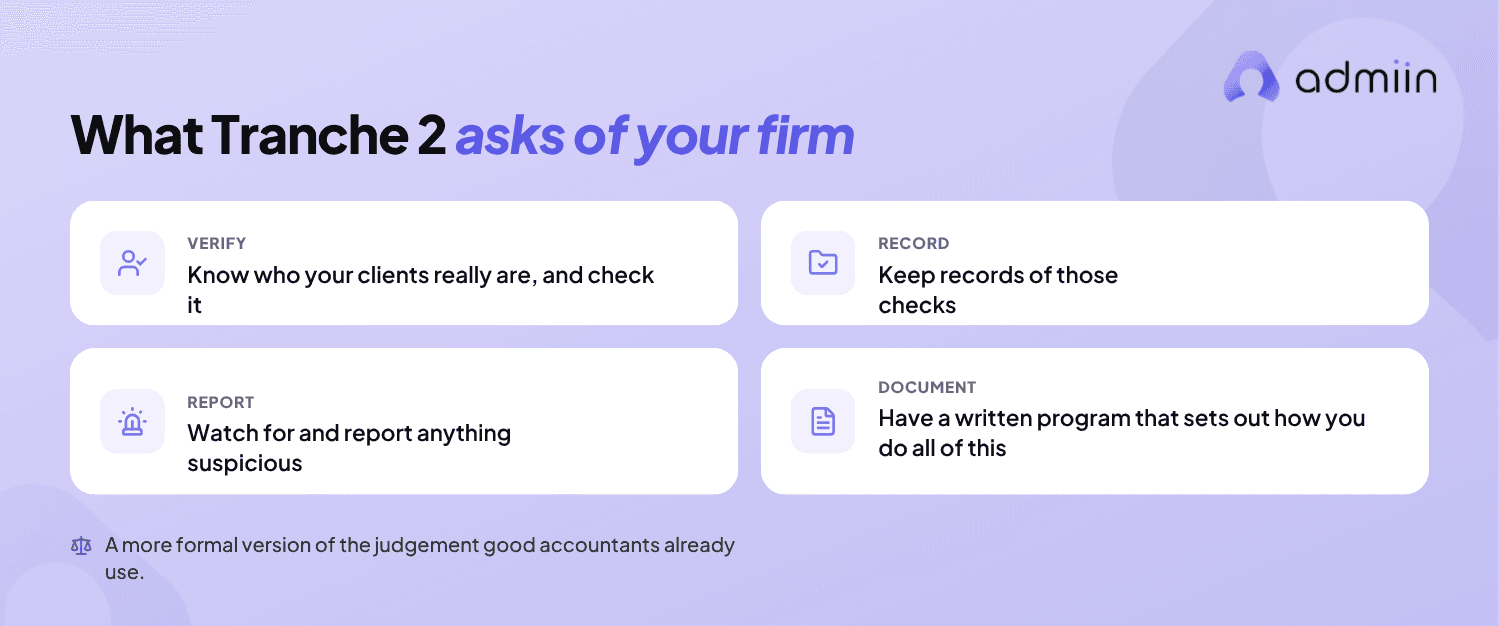
In simple terms, your firm is now expected to:
Know who your clients really are, and check it
Keep records of those checks
Watch for and report anything that looks suspicious
Have a written program that sets out how your firm does all of this
None of that is exotic. Most of it is a more formal version of the judgement good accountants already use. The change is that it's now a legal obligation with an audit trail behind it, not a gut feel.
Your firm's exact obligations depend on your size and services. AUSTRAC has published guidance, and it's worth reading it against your own client base, or getting advice, rather than guessing.
The part most firms underestimate: the back book

Here's the trap. Firms think about verifying new clients from 1 July and forget the clients they already have.
Your existing client list is the back book. Every entity, every trust, every individual you already act for. Under the new rules, they don't get a free pass just because they signed on years ago. You still need to know who they are.
For a firm with a few hundred clients, that's a real project. For a firm with a few thousand, it's the thing that quietly eats the second half of the year if no one starts it. The firms that will struggle in six months are the ones treating this as a "new clients only" job today.
What "knowing your client" really involves
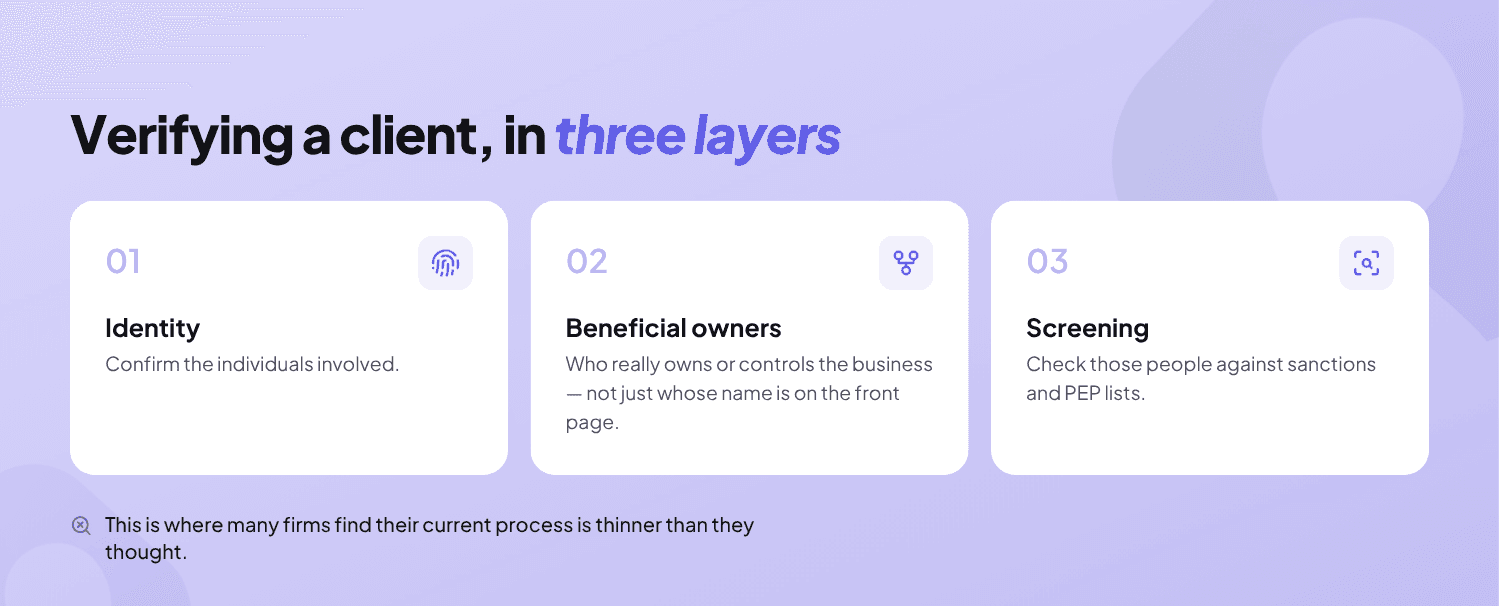
"Verify the client" sounds simple until you look at what's underneath it. For a typical accounting client, it usually means:
Confirming the identity of the individuals involved
Working out who actually owns or controls the business, the beneficial owners, not just whose name is on the front page
Checking those people against sanctions and politically exposed person lists
That last layer is where a lot of firms realise their current process is thinner than they thought. Plenty of firms find their team has been tracking this in a spreadsheet, or not really tracking it at all. Partners often assume it's handled. It usually isn't, not to the standard the rules now expect.
Don't treat it as a one-off
The other mistake is treating verification as a single box you tick at sign-up and never look at again.
The rules expect ongoing attention. A client's situation changes. Ownership changes. A name appears on a list that wasn't there last year. Verifying everyone once and filing it away isn't enough. You need a process you can run again and again without it becoming a full-time job.
The real question for firms right now is bigger than one client. Can you verify every client, including the back book, and keep doing it, without burning out the admin team?
Where to start
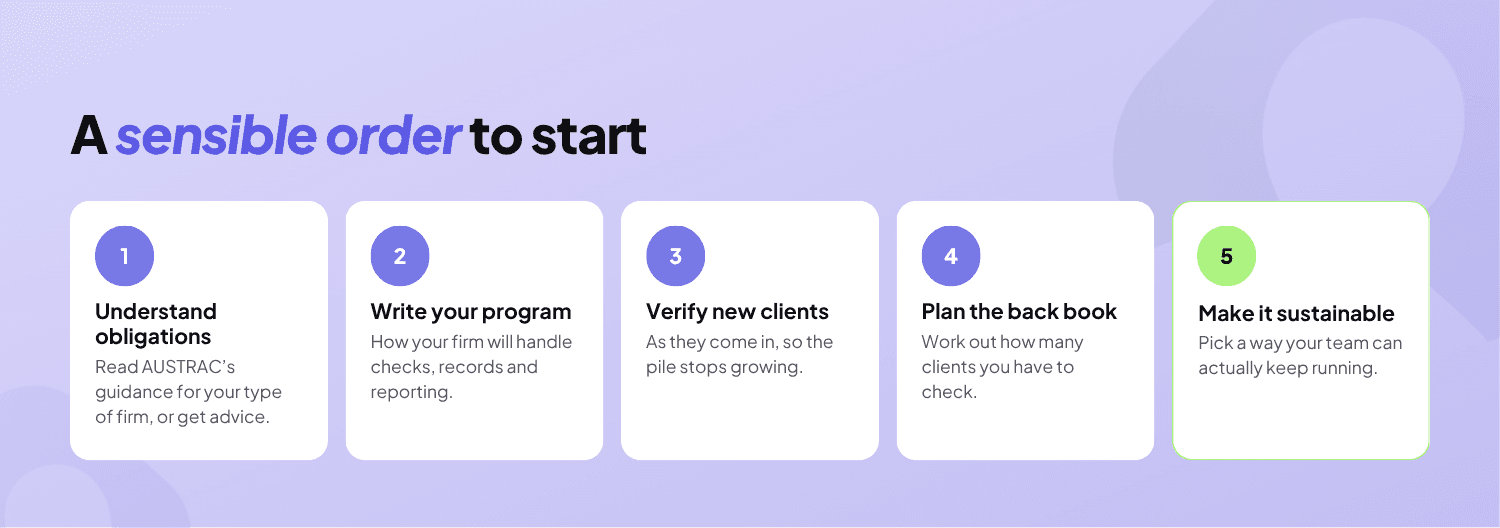
You don't need to solve all of this this week. A sensible order looks like:
Understand your obligations. Read AUSTRAC's guidance for your type of firm, or get advice.
Write down how your firm will handle client checks, records, and reporting. That's your program.
Verify new clients as they come in, so the pile stops growing.
Plan the back book. Work out how many clients you have to check and how you'll get through them.
Pick a way of doing it that your team can actually sustain.
The firms that handle Tranche 2 well won't be the ones who panicked and bought the priciest tool. They'll be the ones who understood the job early and built a process they can keep running.
Where Admiin comes in

This is the problem we built Admiin to solve. Instead of a separate KYC tool your team logs into on the side, verification runs inside the lodgement workflow you already use.
Here's what that looks like in practice:
One click to verify. When you send an engagement letter or a tax doc, the check runs from the same place. The client's details are already there, so no one re-types them into a second system.
The full AML picture in one go. Admiin covers DVS identity checks, PEP and sanctions screening, KYB for the business, and UBO identification. That means you can see who really owns and controls the entity, not just whose name is on the front page.
The back book, handled in bulk. You can bulk verify up to 1,000 clients at once instead of working through your list one at a time. The project that eats the second half of the year stops being a project.
One dashboard for status. See who's verified, who failed, and why, in a single view. Nothing gets lost across tools or spreadsheets, and you have the record trail the rules expect.
It's AUSTRAC-aligned, and because it sits next to the rest of your lodgement flow, the checks become part of the work rather than another job bolted on top. The same platform trims lodgement prep from about 25 minutes to 4, so the compliance side gets faster while the rest of the admin does too.
The core of Admiin is free. If you'd rather stop reading and start doing, you can sign up free and get your first clients verified today. You only pay for the checks you run. No budget sign-off, no subscription trap.
Start free today. The job gets easier once you stop treating it as a side task.