
Darren Hosiosky
It is 4pm on a Thursday in a mid-tier firm. The accountants have finished the returns. The admin team is still going.
Someone is copying entity names into a Word template. Someone else is uploading a binding to DocuSign for the second time because one of three signatories missed their page. A client from last week has signed but paid the wrong PRN, so that one is now a phone call to the ATO. Another firm somewhere is doing the exact same thing, in the exact same order, with the same four tools open.
That is the workflow Admiin was built for. And today it is a finalist in the Australian AI Awards 2026, in the AI Innovator, Start Up category. Winners are announced at the gala in Sydney on 30 October.
The bottleneck sits after the accounting is done

Firms invest heavily in the accounting work. The bit that follows gets held together by hand. On a single lodgement, the support team will usually:
Open the PDFs and hunt down the right cover letter template
Type in client names, entity details, amounts, PRNs, and due dates, which runs about 15 minutes on its own
Merge everything into one binding and upload it to a signing platform
Add the signatories and send, then wait while the email sits in an inbox for a fortnight
Chase the partial signatures, one signatory at a time
Chase the payment once the document is signed, or fix it when it lands against the wrong PRN
Deal with the penalty notice weeks later, which means the ATO on the phone and a reconciliation at the end of it
Every step lives in a different tool. The admin team is the integration layer.
What Admiin actually does
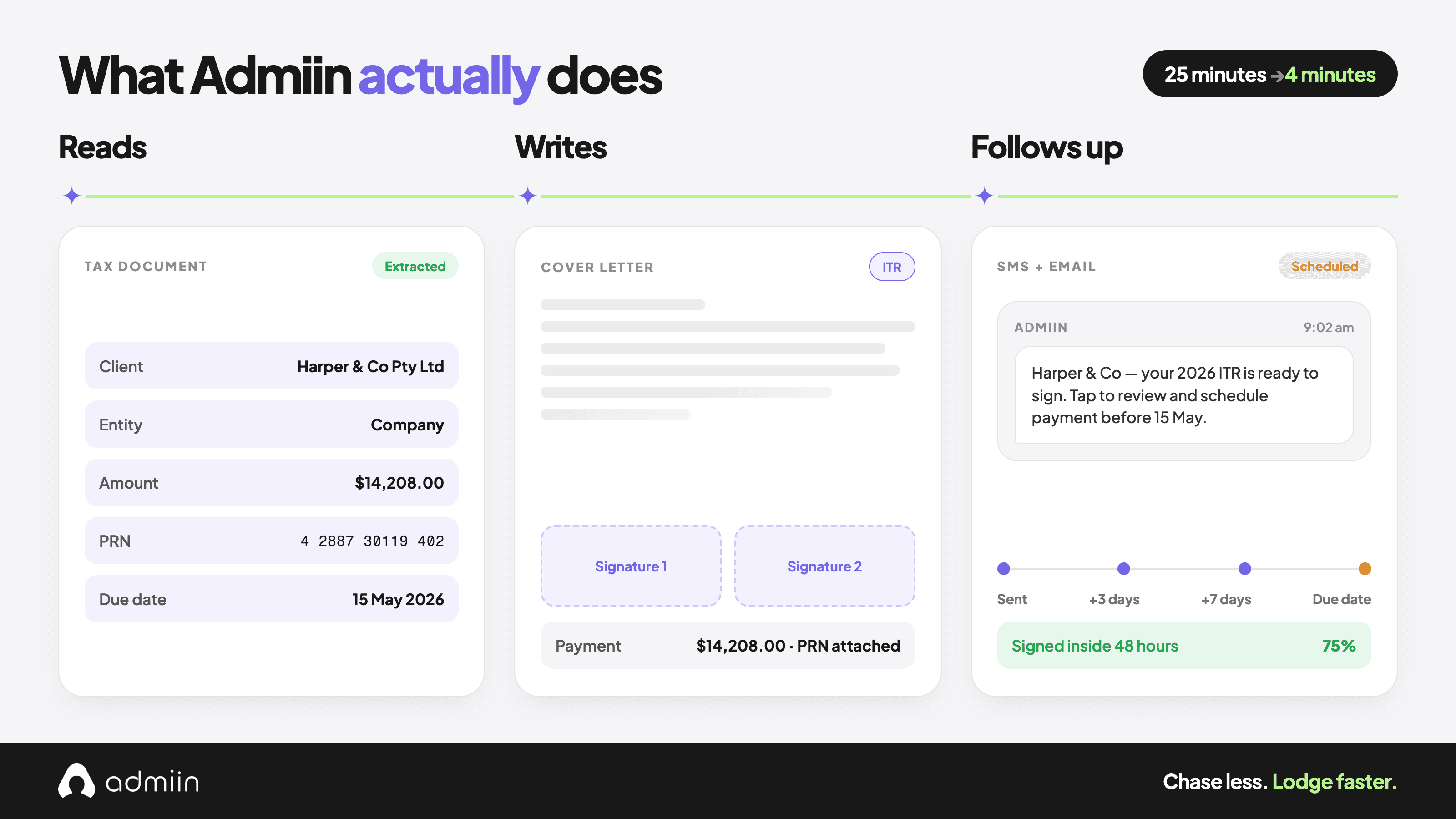
Plenty of software claims AI. Inside Admiin, it does three specific jobs.
It reads the document. Support drags a tax document into Admiin, imports it from XPM, or forwards it to a custom inbox. Admiin pulls out the client details, entity details, amounts, PRNs, and due dates.
It writes the cover letter. The correct format for the job, whether that is an ITR, BAS, PAYG, or a grouped lodgement with several signatories across entities. Signature placeholders and payment amounts are set automatically, with the right PRN attached.
It runs the follow-up. Escalating reminders by email and SMS, timed to the due date rather than to whenever someone in the office remembers.
A job that used to take about 25 minutes of manual work now takes about 4.
The rest of the workflow moves too
The client gets an SMS as well as an email, and signs on their phone. From that same flow they can schedule the tax payment by card, bank transfer, or PayTo, with the correct PRN already filled in and the payment set for two days before the ATO due date. Card fees apply if they choose card, and bank transfer stays free, so the choice sits with the client.
KYC sits in the same place. One click after the engagement letter or tax document goes out covers:
DVS identity verification
PEP and sanctions screening
KYB and UBO identification
It is all AUSTRAC compliant, and firms preparing for Tranche 2 can bulk verify up to 1,000 clients at once and watch the status board fill in.
Support sees the lot on one dashboard. Every lodgement, signature, payment, and KYC check, with status attached.
The numbers behind the submission
25 minutes to 4 minutes. One firm tracked lodgement prep across a full month during beta, with the same number of staff handling far more volume.
$90,000 a year saved. Another firm was paying that across e-signing, document management, and related tools. They replaced the stack with Admiin on the free tier.
75% executed inside 48 hours. Across the platform, most documents come back signed within two days, driven mostly by SMS.
50 firms, zero churn. Firms that start using Admiin keep using it.
Those numbers came from firms doing the work, which is the part worth saying out loud.
Thank you
Thank you to Momentum Media, AI Daily, and the judging panel.
Bigger thank you to the firms who came on early and told us exactly what was broken. The admin teams who sat through the first version, said the cover letter formatting was wrong, said the follow-up timing needed to shift, said the KYC step belonged inside the workflow instead of beside it. Every one of those conversations shows up somewhere in the product today.
And to our investors, who backed the idea while it was still mostly an idea.
Recognition is a good day. Then it is back to lodgements.
Chase less. Lodge faster. The core product is free. Sign up here or book a walkthrough with the team.