
Darren Hosiosky
If AUSTRAC walked into your firm tomorrow and asked you to produce a verified audit trail — every individual, every entity, every beneficial owner you've onboarded since the Tranche 2 reforms took effect — could you?
If the honest answer is "we'd have to dig through four different systems and a shared inbox," you're not alone. Most Australian accounting firms got the AUSTRAC memo in 2026 and bolted on a tool. Few have an actual plan.
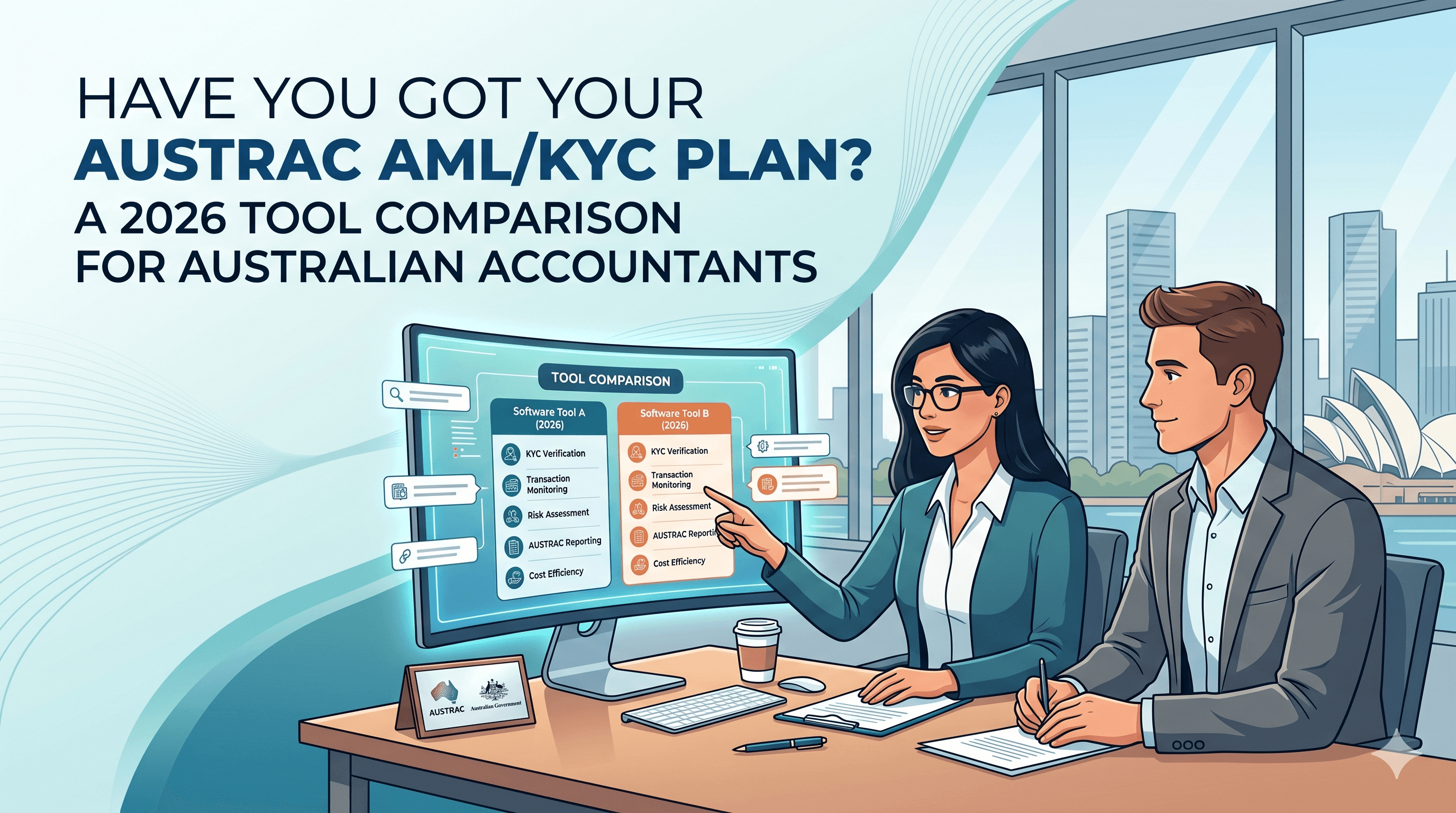
This post is for the firms who want one. It walks through what changed under Tranche 2, the four things every firm now needs in place, and a fair comparison of the AML/KYC tools accountants are actually using — including where each tool ends and the manual work begins.
What changed in 2026
Until last year, AML/KYC obligations sat largely with banks, casinos and remitters. Tranche 2 of the Anti-Money Laundering and Counter-Terrorism Financing Act extended those obligations to "designated services" performed by accountants, tax agents, lawyers, real estate agents and trust and company service providers.
In plain English: if you're providing tax, accounting, business structuring, or trust services to a client, you now have AUSTRAC obligations that look a lot like a bank's. That includes:
Customer Due Diligence (CDD) — verifying the identity of every individual and entity client
Beneficial ownership identification — establishing who actually controls a corporate or trust client (typically anyone with 25%+ ownership or effective control)
Ongoing monitoring — keeping verification current and flagging suspicious activity
Record-keeping — maintaining an auditable trail for seven years
An AML/CTF Program — a documented framework describing how your firm meets all of the above
The penalties for non-compliance are significant, and the regulator has been clear that "we didn't know" isn't a defence. (Tranche 2 is one of three structural forces hitting AU firms simultaneously — we set out the bigger picture in the 36-month reset facing Australian accounting firms.)
The four things every firm needs in place
Forget the tools for a moment. Before evaluating any platform, every firm needs:
A written AML/CTF Program — your policies, procedures, risk assessment, and the staff member designated as your AML/CTF Compliance Officer
A verification workflow — how you actually run identity and entity checks at onboarding, with a documented standard
An ongoing monitoring process — re-verification triggers (new beneficial owner, change in entity structure, suspicious activity)
An audit-ready records system — central, time-stamped, retrievable in minutes not days
The tools below help with step 2, 3 and 4. None of them write your AML/CTF Program for you, and the regulator will ask to see it.
The AML/KYC tools Australian accountants actually use
Here's a fair, practical comparison of the platforms most commonly adopted by Australian firms — what each does well, and where the gap is.
Admiin
What it does: AML/CTF and KYC checks on individuals and entities, embedded directly inside the tax lodgement workflow. Verification runs automatically as part of client onboarding and lodgement, with a centralised audit trail.
Where it shines:
Fully embedded — no exporting, no second login, no separate tool for the team to learn
Automated checks across individuals and entities (companies, trusts, partnerships)
Audit trail lives alongside signed documents, payments, and lodgements in one place
Designed specifically for tax and accounting firms under Tranche 2
Where the gap is: Admiin is purpose-built for the tax and compliance workflow — if your firm needs AML/KYC for a use case completely unrelated to tax services (e.g. real estate transactions outside an accounting context), you'd want a more general-purpose platform.
First AML
What it does: Standalone AML platform popular with accountants and lawyers in Australia and New Zealand. Handles CDD, source-of-funds checks, and ongoing monitoring.
Where it shines:
Purpose-built for the professional services market
Strong UI and templated workflows for common entity structures
Established compliance team that keeps templates up to date
Good support for trust and corporate structures
Where the gap is: First AML is a separate platform from your practice management, e-sign, and lodgement tools. Verification happens in First AML. Lodgement happens elsewhere. The audit trail lives in two systems, and your team logs into both.
FrankieOne
What it does: Australian-built identity verification platform aggregating multiple data sources. Strong in fintech and banking; increasingly used by professional services.
Where it shines:
Aggregates many verification sources (good match rates)
Strong fraud and risk signals
Highly configurable workflows
Australian, with deep integration into local data sources
Where the gap is: FrankieOne is primarily a developer/integrator platform. For firms without a tech team, the configuration burden is real, and pricing reflects an enterprise customer base rather than a 5-partner accounting firm.
NameScan / GreenID (GBG)
What it does: Long-running Australian identity and PEP/sanctions screening tools, now part of GBG. Common in older firm tech stacks.
Where it shines:
Trusted Australian heritage (NameScan and GreenID are both well-known)
Solid PEP and sanctions screening
Bulk-screening capability for large client books
Often integrated into existing accounting platforms
Where the gap is: The product surface feels older than newer entrants. Workflows tend to be export/import or API-driven rather than embedded into the tax lodgement flow. Audit trail typically exports to PDF or CSV rather than living inside your day-to-day systems.
Sumsub
What it does: Global KYC/AML platform, strong in fintech and crypto. Some Australian accounting use, particularly for firms with international clients.
Where it shines:
Excellent support for international document types
Strong liveness and biometric checks
Comprehensive PEP/sanctions/adverse media screening
Robust API for custom integrations
Where the gap is: Sumsub is built for global fintech use cases. For a typical Australian accounting firm verifying domestic individuals and entities, it's overkill — and priced like it.
Annature ID
What it does: Identity verification bolted onto Annature's e-signature platform. Used by accountants who want signing and ID in one tool.
Where it shines:
Convenient if you're already using Annature for e-sign
Reasonable for basic individual verification
Australian-built, simple UX
Where the gap is: Annature ID is an add-on, not a primary AML platform. Beneficial ownership checks on complex entities, ongoing monitoring, and the audit trail required for a Tranche 2 program need more than this product is designed to provide. (For the broader e-signature comparison, see FuseSign vs Annature or the four-way view in DocuSign vs Annature vs FuseSign vs Admiin.)
Side-by-side comparison
Tool | Embedded in tax workflow? | Individuals | Entities + beneficial ownership | Ongoing monitoring | Audit trail | Best for |
|---|---|---|---|---|---|---|
Admiin | ✅ Fully embedded | ✅ | ✅ | ✅ | ✅ Centralised with lodgement | Tax & compliance firms |
First AML | ❌ Separate platform | ✅ | ✅ | ✅ | ✅ In-platform | Mid-large firms wanting a dedicated AML tool |
FrankieOne | ❌ Via API | ✅ | ✅ | ✅ | ✅ In-platform | Tech-resourced firms |
NameScan / GreenID | ❌ Export-based | ✅ | Partial | Partial | Export-based | Bulk screening, established stacks |
Sumsub | ❌ Via API | ✅ | ✅ | ✅ | ✅ In-platform | Firms with international clients |
Annature ID | Within e-sign only | ✅ | Limited | ❌ | Limited | Light-touch individual verification |
Pricing — the real cost picture
The per-check cost across AML/KYC platforms sits in roughly the same range — around $5 per individual check is the standard. The real differentiator is the subscription — what every firm pays each month before a single check runs.
Tool | Subscription (monthly) | Usage fee per check |
|---|---|---|
Admiin | $0 | from $3.62 |
First AML | from $499 | from $5 |
FrankieOne | from $1,000 (enterprise quoted) | from $5 |
NameScan / GreenID | from $299 | from $4 |
Sumsub | from $1,200 (enterprise minimums) | from $6 |
Annature ID | from $99 (add-on to e-sign subscription) | from $5 |
For a firm running 100 checks per month, usage costs are roughly equivalent across all platforms — around $500. The subscription is what doubles, triples or quadruples the annual bill. With Admiin, you pay for the checks you run. That's it.
A note on these figures: AML/KYC pricing is often custom-negotiated and tier-based. Numbers above are illustrative entry-tier pricing in AUD as at May 2026 — verify directly with each vendor before quoting in client conversations. We'll cite each figure once confirmed.
What "the plan" looks like, by firm profile
Firm profile | Likely AML/KYC stack | Risk |
|---|---|---|
Solo / 1–3 partner firm | Spreadsheet + ad-hoc verification + scanned IDs in folders | High — no audit trail, ongoing monitoring nearly impossible |
5–15 staff growing firm | Standalone AML tool (e.g. First AML) + e-sign + practice mgmt | Medium — coverage exists but lives across multiple systems |
15–50 staff established firm | Dedicated AML platform + e-sign with ID + practice mgmt + manual policies | Medium — depends entirely on team consistency |
50+ staff multi-office | Enterprise AML (FrankieOne / Sumsub) + custom integration | Lower — but high cost and significant tech overhead |
The pattern: the more firms grow, the more tools they bolt on, and the more the audit trail fragments. Admiin's pitch is to collapse that — by handling AML/KYC inside the same workflow that handles cover letters, signatures, payments and lodgement, the audit trail is centralised by default.
What to do next
If you don't have a written AML/CTF Program yet, that's the first step — and no tool replaces it. Once that's drafted, the question becomes: which platform actually executes the plan inside your real workflow?
For most Australian tax and compliance firms, an embedded option like Admiin removes the integration burden entirely. AML/KYC checks happen at the natural points in the workflow — onboarding, lodgement, change-of-circumstance — and the audit trail is built as a side-effect of doing the work, not as a separate task.
Get your AUSTRAC plan in place
Small firm? Start free and run AML/KYC checks alongside your next tax lodgement — no separate tool, no integration project.
Mid-large firm? Book a 20-minute demo and we'll walk through how Admiin's AML/KYC fits into your existing workflow and replaces standalone tools.
Frequently asked questions
Does Admiin replace First AML or FrankieOne? For most Australian tax and compliance firms, yes. Admiin handles individual and entity verification, beneficial ownership checks, and ongoing monitoring inside the tax lodgement workflow. Firms with use cases beyond tax services may still need a general-purpose AML platform.
What about my AML/CTF Program document — does Admiin write that? No. Your AML/CTF Program is a written policy framework that describes how your firm meets its obligations. Admiin executes the verification, monitoring and record-keeping that the Program describes. We can point you to template Programs designed for accounting firms.
How does Admiin handle beneficial ownership for trusts and complex structures? Admiin verifies beneficial owners (typically 25%+ owners or those with effective control) for companies, trusts and partnerships, with the audit trail captured against the parent entity record.
Is the audit trail acceptable to AUSTRAC? Yes. The audit trail is time-stamped, centralised, and retrievable in the formats AUSTRAC requires. It's stored alongside signed documents, payments and lodgement records — so a single client record contains the complete compliance history.
How long are records kept? Seven years, in line with the AML/CTF Act requirements.
Do I need to do PEP and sanctions screening too? Yes — and Admiin includes both as part of the standard verification flow.
Suggested internal links
XPM vs Karbon vs FYI vs Ignition: A workflow-first comparison
DocuSign vs FuseSign vs Annature: e-signature comparison for Australian accountants
How to automate tax lodgements: a step-by-step workflow
How accountants can get paid faster: a payment workflow guide
AML/CTF Program template for Australian accounting firms