
Darren Hosiosky
It's the middle of lodgement season. The accountants have finished the work. Now it lands on the support team.
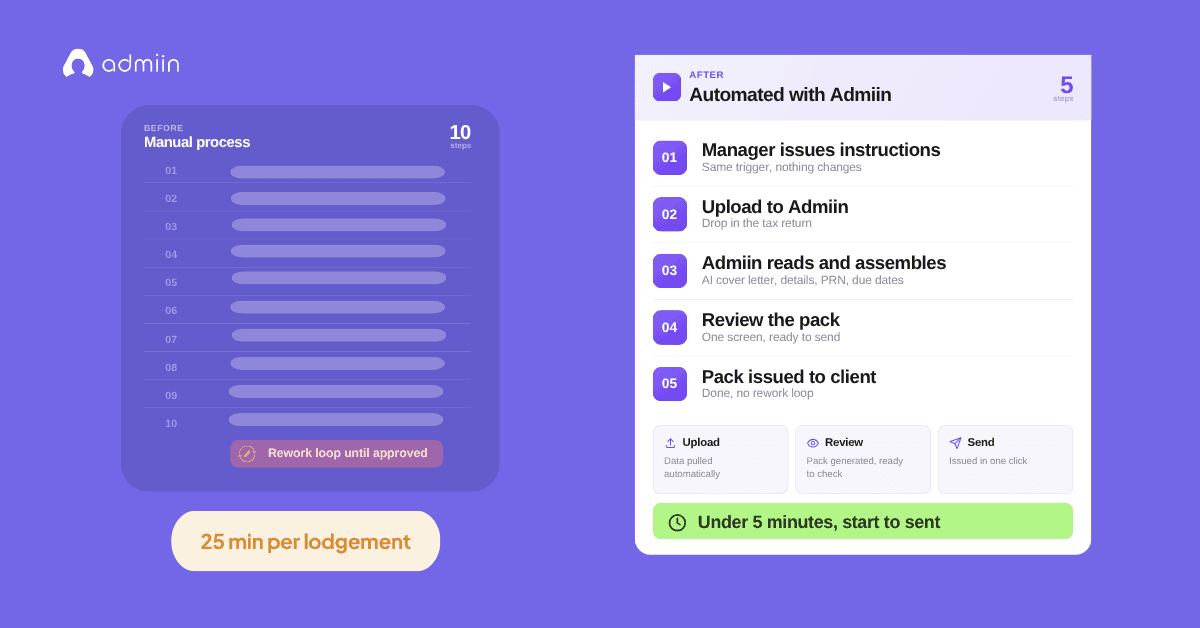
Someone opens the PDF, finds the right Word template, and types the details across by hand: client name, entity, amounts, PRNs, due dates. Fifteen minutes in, and the document still hasn't gone anywhere. Then it gets merged into a binding, uploaded to DocuSign, signatories added, and sent. And the waiting starts.
That's one document. Multiply it by every client on the list, in the same few weeks, with due dates stacking up behind each other. The support team runs dozens of these a day, and each one has its own template, its own signatories, and its own chase.
None of it shows up as a line on an invoice. It sits in the background and sets the pace for how many lodgements a firm can get out the door. The accountants can only move as fast as the admin behind them.
Where the time actually goes
The compliance work takes an hour. The admin around it takes the rest of the day.
The time goes to the same handful of things every season:
Building cover letters by hand, one template at a time
Chasing signatures by email, then chasing the half that only partly signed
Clients who forget to pay, or pay to the wrong PRN
ATO penalty notices that send someone back to chase all over again
None of it is billable. All of it takes time. And it gets worse every season, because the client list grows but the admin team doesn't.
Why it costs more than it looks
Partners think about admin as bums on seats. Another season, another temp, another set of manual steps that only one person really knows how to run.
The bigger cost is the errors that come with doing it by hand:
The wrong PRN on a payment
A missed signatory on a group lodgement
A client who slipped through the follow-ups and copped a penalty
Every one of those is more admin to clean up. Group entities make it sharper again. If a client holds ten companies, the old way treats that as ten separate jobs: ten sets of documents, ten chases, ten chances to get a detail wrong.
What it looks like when it's one flow
This is where Admiin comes in. One workflow replaces the four tools you're stitching together:
Drag and drop the tax document in, import it from XPM, or forward it to a custom inbox
Admiin reads it and generates the cover letter in the right format. No Word templates, no copy paste
The client gets an email and an SMS, and signs on their phone
Follow-ups escalate on their own: day of, days before due, on the due date, and after it
The client schedules payment by card, bank transfer, or PayTo, correct PRN filled in, set for two days before the ATO due date
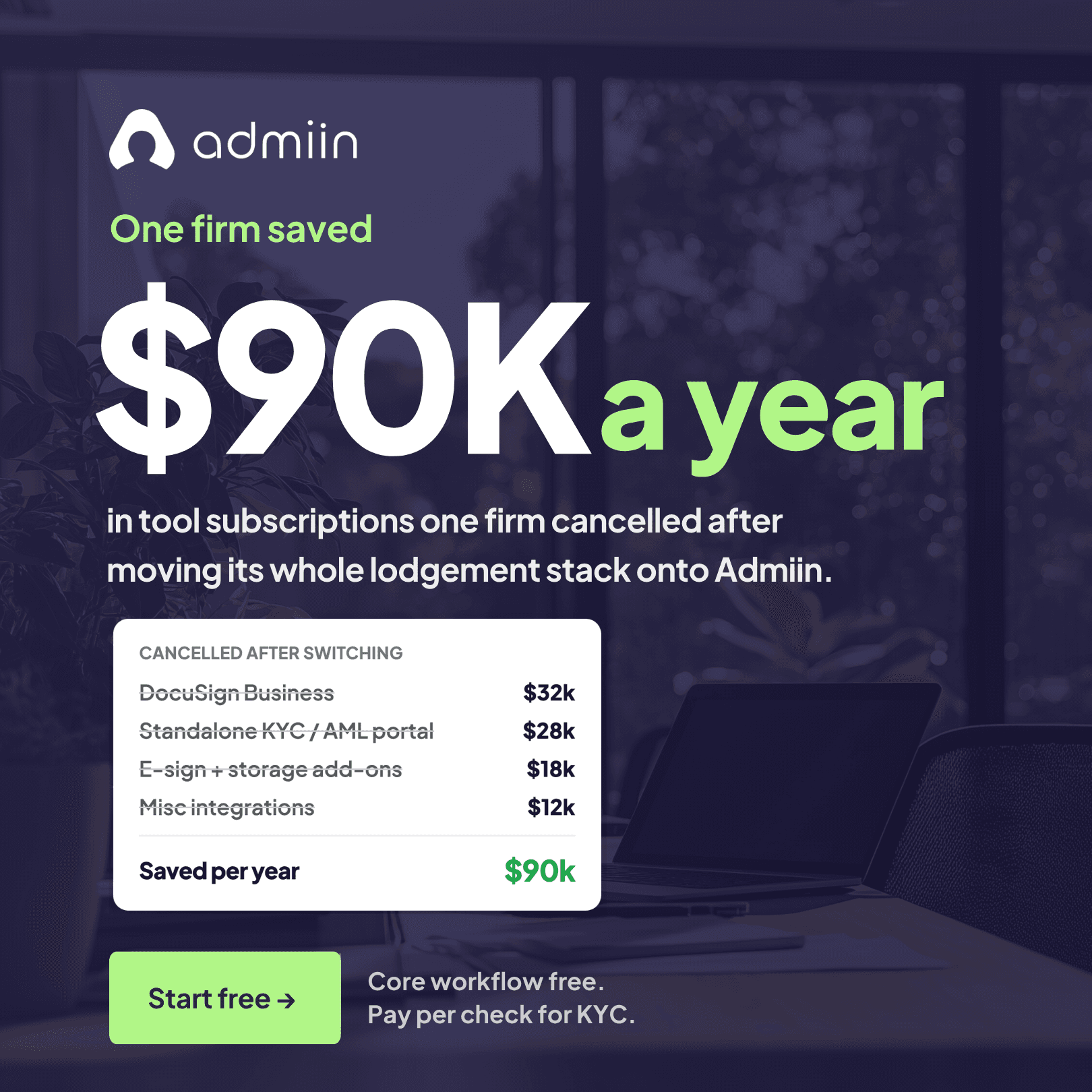
About 75% of documents are signed within 48 hours, mostly because of the SMS. Prep drops from 25 minutes to 4. One firm, Logica, moved across, dropped DocuSign and a few other tools, and saved around $90,000 a year.
Compliance in the same place
KYC runs from the same workflow. One click after you send the engagement letter or tax document kicks off the check: DVS, PEP, sanctions, KYB, and UBO identification, all AUSTRAC compliant. No separate tool, no second login, no re-keying details you've already entered.
For the admin team, that means:
Clear the back book fast. Bulk verify up to 1,000 clients at once instead of working through them one at a time.
Check only who you need to. Verify clients before you commit designated services, so you're not running checks you don't have to.
Stay audit ready. One dashboard shows every pass, failure, and the reason behind it, so you can show your work if AUSTRAC asks.
Skip the duplicate work on group entities. Verify a person once and Admiin carries it across every entity they're tied to. That's one check, not ten.
Because it sits inside the workflow you're already using, KYC never turns into a separate job with its own tool and its own login.
Getting the week back
Most of lodgement season goes to the admin around the work: the cover letters, the chasing, the wrong PRNs, the penalty clean-ups. It grows every season while the admin team stays the same size.
Admiin puts the whole process in one workflow. Drag in the document, get the cover letter, send for e-signing by SMS, let the follow-ups and payments run themselves, and verify clients in the same place. Prep goes from 25 minutes to 4, most documents are signed within 48 hours, and Logica saved around $90,000 a year moving across.
The core workflow is free, e-signing included, with KYC built in and charged per check. So there's a low-risk way to find out if it fits your firm: start with the free e-signing, and bring your next binding through it.